Soft skills are becoming the hard skills of surveying

Surveyors UK
- Business Development & Marketing
- Careers, Jobs & CPD
- Property/Built Environment
- Residential & Housing
- Technology & AI
Every week on This is Surveying, I talk to surveyors from different disciplines, firms and stages of career. One theme comes up almost every time, whoever the guest.
The conversations.
“As a surveyor, you have to be an expert in delivering bad news.” Lewis Denbow MRICS
“You can’t hide behind the iPad. You’ve got to talk to people.” Rebecca Freeman, FRICS
“Party wall surveying, a very small element is surveying. The bigger element generally is being an agony aunt.” Sarah Portnoi (nee Tanner)
“When you walk in someone’s house, you walk into their lives.” Dan Knowles FRICS
The homeowner who’s frightened by the crack above the bay window. The client who needs to hear the build is over budget. The landlord and tenant who can’t agree on a number. Guests talk about these moments more than any technical challenge.
That’s why I don’t think AI will replace surveyors.
The obvious reasons still stand
Judgement matters. So does the physical inspection. So does accountability. When something goes wrong, people want a named professional who stands behind the advice and holds the PI insurance. Under the RICS AI standard, the surveyor stays responsible for the work, whatever tools helped produce it.
But the reason I keep coming back to is people.
Many jobs will change and keep the same name but the mix of their day will look very different.
What used to be soft skills is now hard skills
As AI speeds up the routine work, the skills we used to file under “soft” move to the centre of the work:
- Delivering bad news. Telling a homeowner their dream house has subsidence
- Calming nerves. Walking a first-time buyer through a report full of red flags so they can make a decision rather than freeze
- Negotiation. Rent reviews, lease renewals, final accounts, dilapidations. AI can produce the numbers. Someone still has to sit across the table
- The difficult cost conversation. Telling a client the build is over budget, and keeping both the project and the relationship intact
- Mediation. Party wall and boundary disputes are often more about neighbours than walls
- Reading the room. The vendor who mentions the “little damp patch” a bit too casually. Noticing that is a skill
- Saying no. Holding your valuation when the client, broker or agent wants a different figure
- Translating. Turning technical findings, and now AI-assisted findings, into plain English a client can act on
These are hard skills now because they decide the outcome. The deal gets agreed, the dispute gets avoided, the client comes back. They’re what clients will pay for once the drafting gets faster. And none of them can be learned from a screen.
Surveyors seem to agree. In the RICS Surveying skills report published this month, UK and Ireland respondents ranked critical thinking (47%) and communication (47%) ahead of data and digital skills (44%) as the most important skills for the next three to five years.
The new work is checking
In science, AI now generates far more ideas than laboratories can test. The bottleneck has moved to checking which ones hold up.
Surveying is heading the same way. AI will draft faster, summarise faster and pull comparables faster. The surveyor’s value moves to verifying, judging and signing off.
That takes professional scepticism. My years in audit taught me to ask one question above all: how do we know that? It’s the question every surveyor will need to ask of AI output.
Spreadsheets and calculators didn’t end accountancy. They changed what accountants spent their time on. Mental arithmetic used to be a mark of intelligence until calculators arrived. The definition of valuable work keeps moving.
The question that is very hard to answer: where do juniors learn?
One contributor to the RICS report points out that the tasks graduates have always learned on, such as measurement, document review, reporting and first-pass analysis, are increasingly being automated.
Those tasks were never just admin. They got juniors on site, into clients’ homes and into rooms with experienced surveyors. That’s where people learned how to handle the nervous homeowner and the awkward cost conversation.
You can’t simulate a nervous contractor. The conversation only works if you know what you’re talking about, so technical knowledge still matters. But the communication side is rarely taught anywhere. It’s experienced. And I think it needs to be experienced much earlier.
The model already exists. At Nottingham Trent University, building surveying students can take a full placement year, work on live projects set by firms and every course includes at least eight weeks of professional experience. I’d like to see that become the norm. More placements, more apprenticeships, more time with clients from year one. If AI takes away the old training ground, we have to build a new one on purpose.
One thing to watch
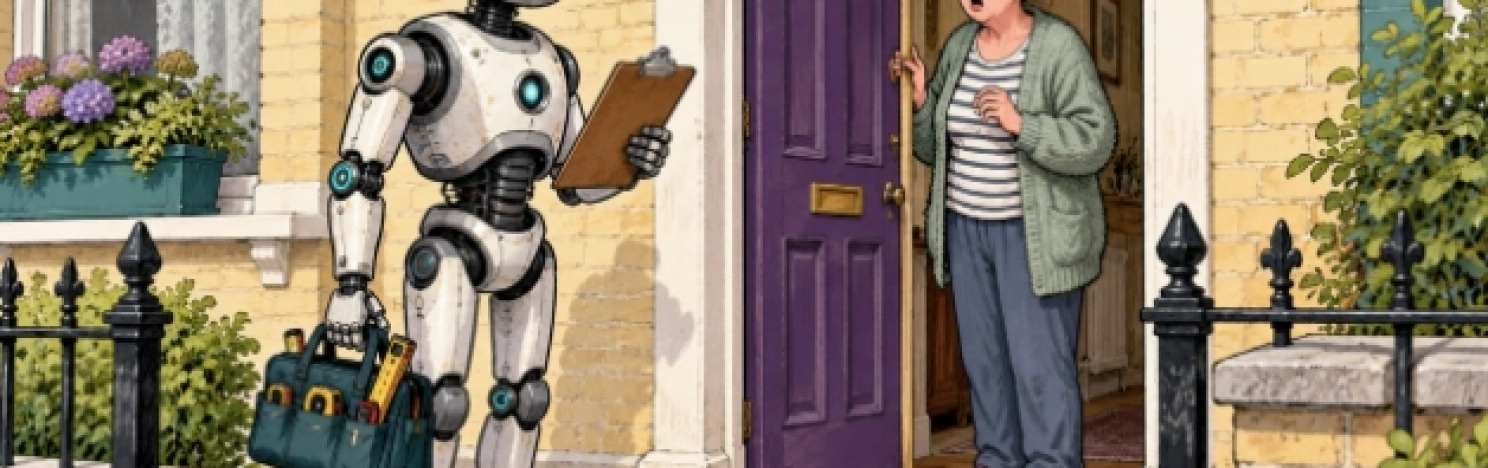
The physical inspection is protected for as long as robotics lags behind. Drones and robots in commercial settings are the exception worth keeping an eye on. Even then, someone has to explain what they found and agree on scope etc.
The bit AI can’t do
AI can draft the report. It can’t discuss a complex report, negotiate a difficult contract or communicate between two angry neighbours.
AI is making it more obvious how fundamental human communication really is.
Nina
P.S. I’m migrating this newsletter over to my own newsletter off LinkedIn – if you don’t want to get left behind add your email here

Nina Young
Founder & CEO, Surveyors UK


