A hammer never ordered its own nails

Nina Young
- Careers, Jobs & CPD
- Risk, Legal & Insurance
- Technology & AI
AI in Surveying, the weekly newsletter by Nina Young
ChatGPT turns four. AI has gone from answering our questions to starting to act on them, and a garden wall shows why the accountability hasn’t moved at all.
TL;DR
ChatGPT is four today. In that time, AI has gone from answering our questions to starting to act on them. It’s a tool, but no longer just a tool. The work is moving further from our hands, and the accountability hasn’t moved at all.
ChatGPT was launched to the public four years ago today.
Increasingly, AI, and generative AI in particular, has moved into our phones, our TVs, our software and our homes. Most of us never chose it. Very few of us were trained for it. Generative AI simply arrived.
So I understand why so many people feel uneasy. Every surveyor I speak to carries at least one worry:
- What will my children’s careers look like?
- Is my own job changing faster than I can keep up?
- What is it doing to the environment?
- Whose work was taken to build it?
- Who is actually in charge?
- How can I use it safely?
- Should I use it at all?
I also keep hearing the same reassurance: “It’s just a tool.”
It is a tool. It’s the word “just” I struggle with. Let me explain with a wall.
Building a wall
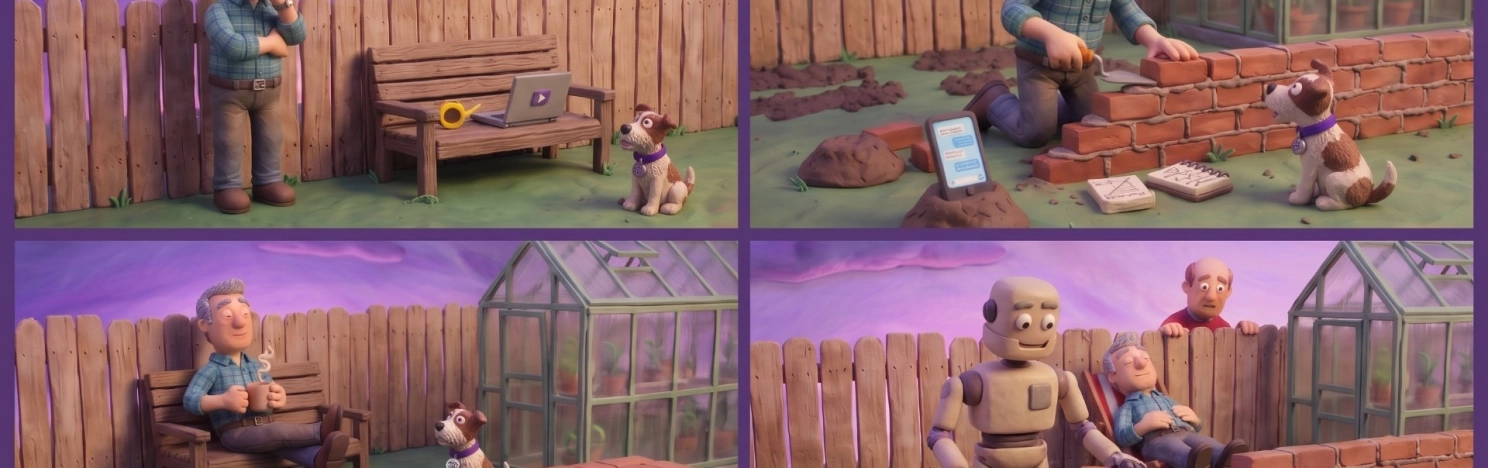
Say you want a new brick wall along the boundary at the bottom of your garden.
Before AI, many of us Googled it. You watched a few YouTube videos. You asked a neighbour, or a friend who knows a builder. Then you pieced it together yourself.
Do I need planning permission? Does the Party Wall Act apply? Where exactly is the boundary? Which bricks, how many, and what will it cost? When should I build it, and who checks it’s done properly?
Every answer came through your own judgement, or someone else’s.
With a chatbot, such as ChatGPT or Copilot, you ask the same questions and get answers in seconds. It explains when a garden wall needs planning permission. It tells you when the Party Wall Act applies and what a notice looks like. It suggests materials and works out the quantities.
But you still check the answers. You decide, you order and you build. The chatbot advises, and you do everything else.
With agentic AI, the picture changes. You don’t ask a string of questions. You say, “I want a wall,” because the wall is the outcome you’re after.
The AI agent works out the plan and the measurements. It checks the planning position, drafts the party wall notice, finds a supplier, orders the bricks, pays for them and books the delivery.
We’re not fully there yet. Today’s agents still trip up, and most of us haven’t let one near our bank card. But this is where things are heading, and fast. Every month, chatbots pick up more of the agent’s abilities, and the line between the two gets harder to see.
Then comes the robot. Bricklaying robots are already working on some UK building sites. In my view, at some point the AI won’t just order the bricks. It will lay them too.
At each stage, the work moves further from your hands.
A hammer never ordered its own nails.
The answer nobody can read
Something happened ten days ago that shows how far this has already gone.
A mathematician announced that he had used AI to prove the Riemann Hypothesis. It’s a problem about prime numbers, first set out in 1859, and it’s widely seen as the most famous unsolved problem in mathematics. For 167 years, nobody could crack it.
The mathematician works at Anthropic, and the AI was their model, Claude. The first version of the proof ran to around 17 million lines of computer code.
The experts who check proofs like this by computer say they have full confidence it’s correct. It has since been shortened, but mathematicians have only begun to work through it. The mathematician himself has said he doesn’t fully understand parts of it.
It isn’t a one-off, either. In September, OpenAI announced that its AI had solved another of the great unsolved problems in mathematics.
We may now have the answer to the most famous problem in mathematics, and nobody can yet read it.
This is why “tool” feels too small. I’m not saying AI is alive. It isn’t a person. But it can plan, act and produce work that nobody can yet explain. We don’t have a word for that yet.
When we haven’t got a word for something, we reach for the nearest one we know. “Tool” makes it sound smaller and safer than it is. And the gap between that word and what people see in the headlines is feeding the fear.
When the wall falls down
Back to the garden. Six months later, the wall falls onto your neighbour’s greenhouse.
Who answers for it?
- You. AI isn’t a legal person. It can’t be sued or prosecuted. So when something goes wrong, the law looks for a person or a company. That starts with the choices you made: what you asked for, and what you checked.
- The supplier. They’re still responsible for selling bricks of satisfactory quality. But if the agent ordered the wrong bricks, that one comes back to you.
- Whoever built it. Someone is responsible for doing the work with reasonable care and skill. If a robot laid the bricks, someone owns that robot and answers for it.
- The party wall surveyor. If your neighbour doesn’t agree to the work, surveyors are appointed to settle it, and a surveyor signs the award. An agent can draft the notice. It can’t be the surveyor.
- The AI company. Read the terms. AI companies limit how much they’re liable for.
- Your insurer. Will your policy cover a mistake made by an agent acting for you? Ask your broker. Don’t assume.
Almost every task in that chain can be handed to AI or a robot. The accountability can’t.
The work moves further from your hands. The accountability stays exactly where it was.
This is already your wall
Swap the garden for your firm.
The survey report drafted with AI. The valuation that leaned on an automated comparable search. The cost plan an agent pulled together overnight.
The work may be faster, and some of it may not be done by you at all. But the signature is still yours. Where AI has a material impact on your work, the RICS standard is clear that you remain accountable.
Meanwhile, a new generation is arriving.
More than one graduate has told me the same thing, and I’ve heard it from people around them too. AI is being used under the desk, in firms that ban it or barely allow it. It’s happening in neighbouring professions, and surveying is no different.
One graduate told me they’re frustrated enough to look for a new job, somewhere they’re allowed to use AI.
In my view, this is going to become a real pressure point for firms that want to hire. The people coming through have used AI throughout their studies. If a firm shuts it out, some will leave, and the rest may use it anyway, where nobody can see it or check it.
So the wall is already being built in many firms. The only question is whether anyone knows who’s building it.
This afternoon
Today I’m on the “Trust by design” panel at the first RICS Technology and AI Summit in London. It’s about how firms use data and technology in a way their clients can trust.
In other words, making sure someone can always answer for the wall.
If you’re there, come and say hello.
If you’re not, try one thing this week. Pick a task, let AI help with it, and question every answer it gives you.
You don’t have to like AI. You do need to understand it, because the wall is already going up.
Nina
Get AI in Surveying straight to your inbox every week, with extra content including articles from across the media. Sign up here.

Nina Young
Founder & CEO, Surveyors UK