Party Wall Software, AI and Surveying’s Future

This Is Surveying

Party Wall PRO
- Building Surveying
- Property/Built Environment
- Residential & Housing
- Technology & AI
What happens when AI meets party wall surveying?
Philippe Weyland, co‑founder of Party Wall Pro and former corporate lawyer, joins me for a candid conversation about how technology is reshaping surveyors’ work. He shares the story of moving from law into software, why communication is the number one skill for surveyors, and how AI is changing both client expectations and professional identity. From the challenges of selling software to an older generation of surveyors, to the rise of AI‑generated complaints, and finally to the millions of data points Philippe has analysed with private AI models, this episode explores where surveying is heading and what surveyors need to do to stay trusted and relevant.
What We Cover
- From corporate law to building Party Wall Pro
- How COVID accelerated digital adoption in surveying
- The rise of AI and the challenge of adding value
- Guy Crouch’s success story: YouTube, outsourcing and AI for leads
- Why communication creates five‑star reviews
- AI complaints and the “slop grenade” problem
- Transparency, billing models and reluctance to admit AI use
- Professional identity, ego and resistance to technology
- Universities, critical thinking and the next generation
- Parallels with the internet and calculators
- Google’s decline and AI reshaping discovery
- Analysing millions of Party Wall Pro data points with AI
- Postcode hotspots and dispute resolution times
- Rethinking billing: risk‑based and outcome‑based models
- The future of Party Wall Pro and AI in surveying
- Final reflections: communication, identity and adapting to change
Guest Links
Party Wall Pro
Philippe Weyland – LinkedIn
Party Wall Pro 2026 Data Report
Guest Bio
Philippe Weyland is a lawyer turned software entrepreneur and the co‑founder of Party Wall Pro, a platform built to simplify and modernise party wall surveying. Since 2015, he has worked closely with surveyors to design tools that reduce errors, improve communication, and adapt to changing client expectations. Philippe is also a strong voice on how AI is reshaping professional identity, billing models, and the future of surveying practice.
If you want to connect with surveyors across the UK and keep up with the profession, join The Surveying Room. It is free to join and open to all types of surveyors, students, and professionals who work with them. Surveyors UK & The Surveying Room
Connect with me – Nina Young on LinkedIn
Transcript
Nina Young: 00:08
Hello and welcome. You’re listening to This Is Surveying, the podcast shining a light on the people, ideas, and stories shaping this incredible profession. I’m Nina Young, founder of Surveyors UK and the Surveying Room, the community bringing surveyors together, breaking down silos, and making surveying visible. So for now, let’s dive into our latest episode. Hello everybody, and welcome to this week’s edition of This Is Surveying. Today’s guest is Philip Wayland. Welcome, Philip. Good to see you on here today.
Philippe Weyland: 00:47
To be here. Thank you very much, Nina.
Nina Young: 00:49
Yeah, I’m very looking forward to our conversation. Lots of things to dive into today. So Philip Wayland is the co-founder of Partywall Pro, a party wall software solution which has been established since December 2015. And Philippe is also a lawyer. So I think we’re going to have some lots of interesting things to discuss today, and especially something that came to light recently regarding data and using AI and the insights that that has enabled uh Philippe to share with us today. So as always, we start the sessions with getting to know a bit more about you, Philippe. So why from lawyer to then and then party wall pro? How did how did that come about?
Philippe Weyland: 01:37
I just was just bored. So so yeah, I started so I was a corporate commercial lawyer for a big American firm before moving in-house. And um I was I was always dealing with IT and stuff, and so I I was always kind of interested in software. And then I thought, you know what, I I could try to develop my own software, and it’s how difficult can it be? And little did I know. And so I started, so I thought, you know what, I’ll
Philippe Weyland: 02:05
try to find a niche and talk to people and see if there are problems that can be resolved by software. And so I started talking to surveyors and I and I started really liking them because they were just about a good bunch. And then more and more people were telling me, yeah, party wall is is really just a copy and paste exercise. It’s really annoying because we make so many mistakes. This could really be dealt with by by software. So I thought, yeah, I’ll just put something together. And I went to see a few people, Ashley Patience being one of them, who who was interested in in the early days. And so I started, yeah, I started building it. So it was a it was a very rubbish MVP at first. And and over the years we we kind of slowly increased the the number of functionalities and polished it and and stuff. Had I known it was going to be those this difficult, I might not have done it because it was it was hard to sell at first for sure, because of it’s it’s uh party wall surveyors are are kind of the the the older generation of surveyors that end up in that. And and so there’s this kind of common saying that party wall surveyors, like the average age of a party wall surveyor is about 70. Because because I was even talking to a a customer that I think it was two or three years ago, maybe, finally cancelled his license because he was retiring at age 82 or something. I can’t even remember, but I was really impressed by it. It was amazing. And he was actually using my software as well. And and so it was hard because they’re all kind of set in their ways, right? They have their spreadsheets, they have uh they have their email, they have their calendars. And slowly, gradually, you have kind of the the younger generation that that came in and and it started to grow. And and it was COVID was was a good time for us because everyone realized that well, with everyone working from home, we need a centralized system so that we can issue kind of the notices from different offices and stuff, uh, one one particular template and and follow, follow all that. So that’s when it took off. And then yeah, and then the rest is history.
Nina Young: 04:15
I just will say though, I just want to say so it’s interrupted, Philippe, but I think it’s testament to your software that you had an 82-year-old partyable surveyor using your software, because it must be sort of easy to navigate and use, because let’s face it, it’s this is something I see I hear a lot with with software solutions and surveying. Very hard demographic, very hard profession to sell to because they have ways of working. It was generationally average ages are more up in the 50s, 60s, not not 82 is like that’s that’s the first I’ve heard of that age using software. That’s incredible. I just want I just wanted to say that because I think that’s that’s something that you know is testament to clearly what you have built.
Philippe Weyland: 04:59
Yeah, thank you. It’s it yeah, it’s true. It’s true. Um, and I I get that a lot. So, yeah, well, you don’t we don’t need uh to have a training call because we we can we can use it. Uh but since then we’ve maybe added too much, so it becomes bloated, and so people getting confused, especially lately. We’ve we’ve added quite a few things because we need to stay on on top of things with AI coming. Um and it’s so so this is what I was going to say. The last 12 months have been a bit tough, I have to say.
Speaker 2: 05:28
Okay.
Philippe Weyland: 05:29
Because um one consolidation in the market, I think parts you all that they I’ve seen quite a bit of consolidation, but on the other hand, uh you can see that the young guys are are slowly thinking, well, you know what, I can do that myself. I don’t need to be part of a bigger, a bigger company. And and then the other thing is AI. So people who’ve used only a fraction of my software, i.e. just to issue notices, they’re like, well, I can do that with ChatGPT. I just dump in my spreadsheet and then and then it does it. Okay, good. And and so we have to kind of think how we can add value. And yes. So again, I’m talking to my customers, I’m talking to other people, which I’ve been doing for the past 10 years, and to try and get some feedback on you know what else. And this is how the communication came in. This is why I I looked at these reviews because a particular customer came up to me, and this this guy’s amazing. He’s called Guy Crouch, he’s uh from Manchester Party War. He’s young, he’s built systems. He only started two or three years ago, I think. And his practice just is doing so well. He started by posting a couple of YouTube videos explaining the act and stuff.
Nina Young: 06:49
Yeah.
Philippe Weyland: 06:49
And and and targeted his local market, very localized. And and then because he’s such a nice guy as well, he takes the time to talk to his owners and stuff. I think words spread like wildfire. And he so that’s when he he came to us, said, Yeah, I need a system. So he started using our system. And now he’s recruited his his uh his first guy. He outsourced all his admin to Graham Kinia from Moorus. I don’t know if you know Moorus, uh M-U-R-U-S.co.uk. Right. So he’s he’s doing a service that um you can, as a one-man ban, you can outsource all your party wall admin because because he has a team that know about party wall. And so they can kind of jump in very quickly. Um, and so he did that. And now the last call I had with him, he’s trying to use AI to get more leads and and aggregate those leads and qualify them as well, and try to even have them sign a letter of appointment using automation,
Philippe Weyland: 07:50
which is really, really cool. And it’s it’s it’s such a change from 10 years ago where I had to do all this. And and so, and so he was the guy who approached me and said, Okay, I want to make a difference, I want to communicate more with my customers because I’ve I’ve I’ve noticed that there’s it makes a massive change, a massive difference in the way that they respond. So he wanted a system that whenever he does something, he issues a notice, the system drafts an email for his owner, his appointing owner, saying, I’ve drafted those, I’ve sent those notices out. Um, they have now 14 days to respond. I’ll be in touch when I hear from them. He just needs to click send and it goes. And then 40 days later, when he issues a 10-day letter, another email gets created saying, I’ve just had to chase this particular joining owner because he hasn’t responded. Bam, sends the email. And so, of course, before before building that, I thought, I’m just gonna have a look if it’s actually a common problem. And this is why I try I I kind of crawled through thousands of reviews, all saying the complaints were the one-star reviews were we were kept in the dark, the surveyor didn’t even bother returning my calls, answering my emails. I had no idea where I was at. And I can completely understand that because those guys are juggling hundreds of jobs a year. So you’ve got thousands of adjoining owners flying everywhere. So you’re not going to come down and send an email because the problem is an email, you have to you have to mention who the adjoining owner didn’t respond, who responded. So that means that you have to open your paper files, go through it. So the drafting of the email takes about 30 minutes. Wow. And and and so, but the five-star reviews that we saw were all about, oh yeah, the guy just kept me in the loop every week. I knew where we were and stuff. And so it’s a very, very simple thing. It’s not, you don’t have to kind of reskill your your your stuff. It’s just yeah, it’s just base, basic communication skills and make a massive difference. And so, you know, a happy owner will uh will obviously take to talk to his neighbor and and recognize it.
Nina Young: 10:04
No, true. I mean, that whole thing, communication is is to me one of the number one skills for a for a surveyor. And it’s something that frequently gets mentioned when I talk to surveyors on the podcast. It’s one of those things that you’re not necessarily taught and something that you learn over time with experience, but also that sort of leads on to one of the things that we’ve we’ve already discussed before we started recording today, which was around communication and also around the increase that people are receiving in queries, you know, long queries using AI, complaints and things like that. And one of the things that’s before before we ex we we discussed that, one of the things that I came across only recently was a surveying firm in residential who had experienced increasing complaints because of AI. People are just using it now very easily. And they said the best way to deal with that was to pick up the phone. Because if you try and respond to 25 queries with a complaint on email, it’s a nightmare. And they found the most successful things because the majority of the time they just use the AI to send it off. They hadn’t really read it, they’re just using it. And I think you mentioned something slop grenade. Yes, yes, yes, which is a brilliant term, which is where people just literally pile it all and use the AI and they just throw it across to the other party. And they said, because you’ll speak to them on the phone, they’ll they won’t they won’t know what they’ve sent. They won’t be able to, and it kind of it’s not about catching them out, they’re a little bit on the back foot, but then they realize that you know they have to take responsibility for what they’ve actually sent.
Philippe Weyland: 11:43
Yeah, yeah, exactly. But why do you get a slop grenade in the first place? I think it’s because you haven’t taken the time to sit down with them properly and explain the process from the start. And and this often happens, and and these were some of the reviews. Like they don’t understand the process. They don’t understand that once you send notices, you have to wait two weeks. Two weeks is a very long time when you’re so desperate to start works. So it’s just sitting down with them and and saying, okay, well, this is the going to be the process. So there’ll be there’ll be a lag, there’ll be moments where you won’t hear from me because I’m gonna have to chase the adjoining owners who haven’t responded. Yeah. And that kind of stuff. So it’s also educating the uh the building owner to go and talk to their neighbors about it. And it it it’s that, but obviously, do you really want to waste time before they even sign a letter of appointment? I’m not sure. This is might be maybe why they don’t they don’t really do it. I don’t I don’t know.
Nina Young: 12:41
But so so these, yeah, these I think these slop grenades can be avoided
Nina Young: 12:45
if you if you from the outset you start uh I think that’s a really really good really good advice, Philippe, because it’s one of the things I’ve been sharing is that you know, be communicate clearly with your clients. You know, I’ve even suggested, you know, okay, you everyone’s using AI, and obviously you have to be transparent. As an RICS member and firm, you have to be transparent of the use of AI, you have to disclose that. But also is educating your client because nine times out of ten, they’ve just got a free version of a chat GPT on the phone, they don’t understand the the data, the like the security of what they’re putting in, but also the limitations, the hallucinations, and the bias. And I’m like, tell them if you if you do choose to, and I know lots of us won’t want to do this, if you do choose to put our reports into these tools, please be aware of X, Y, and Z. Because then up front you’ve gone. I know if you do it, you’re gonna do it. And I I think there’s something to be said. If you can talk to someone, not necessarily email, but you know, and this, you may want this. Come back to us, ask us the questions, you know. You may, you know, and I think that’s that’s where we’ll have to head because everyone will be using it eventually. You know, it’ll be like the internet, it’ll become an accepted way of doing things. But I think right now, it like you say, it’s educating your clients or your potential clients.
Philippe Weyland: 14:01
Yeah, and we’re all competing against AI, that’s yes, I know.
Nina Young: 14:05
And it’s like but yeah, we’re the ones that humans are the ones that have developed it, and it’s like AI is its own identity, and it’s it’s not, it’s it’s humans that have are responsible for what it’s developing. It’s you know, all of this fallout. It’s not the AI that’s just got up and done it itself. It’s um it’s an interesting time that we’re in at the moment. Some of the other things that so we we we touched upon uh covert AI, which is where there’s a reluctance to disclose the use of things, um, the use of AI or the use of technology full stop. And I think you said something to me about a best kept secret.
Philippe Weyland: 14:41
Yeah, so that’s that’s um that’s one of my customers said that a long time ago. It’s like, yes, you uh Pachi WarPro is the best best kept secret in the industry. Why? Because it it gives it gives an edge to uh to its users, but they don’t they don’t want to talk about it. And this has been my downfall because that means I’m the one, I’m the only one trying to sell it, as opposed to when you have a product that people share, it’s just like, oh, it’s really easy. And and it’s and why is that? And I’ve had a few meetings where it’s been discussed where people say, well, look, if we charge by the hour and we use a software that instead of taking two hours to draft notices, it takes me two seconds. Well, how am I going to charge? And I was I was a bit baffled by it at first. Yeah, oops, that’s not good. And and this is this is a problem that lawyers face as well, especially with AI now.
Speaker 2: 15:35
Yes.
Philippe Weyland: 15:35
Um when when your your your billing model is is kind of getting a bit antiquated. And and it’s you know, my response now is like, yeah, okay, but you can take on so much more work as well. So but how can you justify justify that? Well, you have to change your your your billing billing method, and and that’s something I’m gonna I’m gonna talk about later when I show you the uh data that I I gathered, is you know, assess the risk, assess the how long this job is going to take, and and then and then bill accordingly. Or quote accordingly, at least. And uh and so so yeah, and and you you can see that with AI now. So many, so many people use it and and don’t don’t tell anyone about it. Well you can you can see it in an office.
Nina Young: 16:23
Yeah, it’s it’s that’s so true. You’re right, because that is that is happening everywhere. Like surveyors are very reluctant to admit they use AI. Firstly, you know, there’s it hasn’t helped with some people saying it’s lazy. I mean, I’ve heard, you know, there’s been all of that over the last few years. I think that’s that’s kind of going away, but they don’t want to admit it. And I did a post not so long ago around the fact of the how it will affect fees. And it, you know, interestingly, there’s a lot of defensiveness about it. Yeah. But also there’s a lot across all professions, consultancies, it’s it’s you know, they’re saying the move will be to outcomes, outcome-based pricing, not by the hour anymore. And I think that’s inevitable. But I think we’re in that messy time, aren’t we? It’s like it’s transitioned, so nobody wants to talk about it. It’s yeah, yeah.
Philippe Weyland: 17:11
But what is that? Why so it’s kind of the psychological element of it? And I’m trying to think about it when I because it’s true. Like you you do use AI a lot, and why wouldn’t you be open about it? Is this some sort of weakness that you kind of say, well, were you admitting to laziness? No, I think you’re just being efficient and using the tools of our times.
Nina Young: 17:35
I think it comes back to which I’ve talked quite a lot about. There’s an amazing book by Suskind and Suskind, which is actually on my bookshelf, The Future of the Professions, which came out. Yes, yes, yeah. Um, and I think brilliant book, absolutely amazing. And m my view is that AI is is seen as a threat to professional identity. It’s, you know, being a professional, it’s your identity. You’ve worked all your life being this. To then suggest you’re using something to make your life easier, it’s almost like, well, I work hard, you know, this is this is I’ve spent years doing this. You know, it’s almost like it’s it’s seen as not necessarily cheating, but an easier route out. And people like to be perceived as hard graft. I know all of this, I don’t need anything else. There is a lot of ego, there’s a lot of ego out there as well. And I think that’s a big part of it. I think that’s a big there’s a resistance, and nobody wants to admit they’re using it because they don’t feel they don’t want people to know that they might need it. I don’t know, that’s kind of my take on it. Psychological kind of identity.
Philippe Weyland: 18:44
Yeah, it’s uh yeah, it’s true, yeah, it’s true. I think the ego, ego gets in the way as always. I’m very worried about the effect on on brains in general. I’m not letting my kids touch it yet,
Philippe Weyland: 18:55
because I want them to actually develop that kind of gymnastic of thinking for yourself. And and that’s for me, that’s the biggest thing because are we gonna have Alzheimer’s at the age of 25 soon? It’s because we never use our brains.
Nina Young: 19:09
That is that is a real concern, that critical, that cognitive. And you know, speaking to lecturers, we had a lecturer, Adrian Tagg, building surveyor on the podcast, who’s amazing, University of Reading, and he was talking about how they’re having to try and tackle AI at university and the difference between getting them to do something, a a test or something online versus in person, and the scores drop considerably when it’s in person because they’re using AI. And then how do you use AI? They actually, you know, universities. I think this is a whole another kettle of fish is how they’re going to come to grips with something that’s moving so fast because universities are not set up to move quickly and adapt to being able to have continually that cognitive, that critical thinking when you can’t stop the use of it, you won’t be able to stop it. I think it’s really that’s a really challenging thing. And I agree about that. I think some people don’t use it correctly, they use it to be lazy. I think that’s human nature, isn’t it? Easier route. We know this is happening, students use it, people are using it all the time for complaints, things. And I think that is a is a concern. I think you’re right. I think there’s a lot of there’s a lot of concern out there for future generations.
Philippe Weyland: 20:21
Um remember the concerns? We had. Do you remember the concerns we had when when the internet started?
Nina Young: 20:29
Yeah. So much resistance to the internet. There was so much resistance.
Philippe Weyland: 20:35
Do you remember when you first put in your credit card details online? Oh I remember that. I was like, it took me months, and then I said, you know what? I’ll just do it now. And and then you’re like, whoa. And now you don’t think about it twice. And it’s it’s the same kind of thing. It’s just like, whoa, should I should I put my my stuff in there? But then the AI will know that that I have two kids and that I I live there and stuff, and it’s these, it it’s it’s back there. And I I remember that, like the internet when it first started. I was like, oh.
Nina Young: 21:09
One of the one of the ones I I I always say is um as be being an accountant, this one always comes to comes to mind, is the is when calculators came in. Oh yes, yeah. There were demonstrations. There are actually examples of demonstrations, and there were some notable ones in America where teachers, and accountants were demonstrating against the use of calculators. It was a big and now look, and it’s like, and it was all it’s gonna replace us. We won’t need nowhere near as many accountants, whatever. That never happened, and I do think there’s an element of that with AI is like I think it will create new roles. I think all all that. I mean, it’s gonna change things, but the whole is gonna replace everybody. I’m still skeptical. Yeah. You know, you know, but I think going back to young minds and the effect that is yeah, protecting children from the use of it is crucial from a early age. Don’t want that because But then is it like the internet where like I always I like I like um pub quizzes and you know because you still you can’t use your phone, you’ve got to and and I I do wonder with the whole now, it’s it’s been very much we are now generations, where if you don’t know it, as long as you know how to use Google, you’ll you’ll find it. So you it’s like you don’t you’re not retaining that information anymore. It’s no and how our brains were affected by the internet and the ability to search. And now I think it will then be replaced by well, I can use my AI AI and then it’ll be my AI agent, and we won’t retain and has it rotted our brains. I don’t know. I think I think AI is very different though. It’s a whole different level, isn’t it? Really?
Philippe Weyland: 22:42
But actually, you mentioned Google. Have you have you noticed how rubbish Google has become? Yes. Whenever I’ve I tried to find something, I’m like, where is everything gone? So we’re gonna use the AI function.
Nina Young: 22:54
That’s what it’s prioritizing ever since. It wants you to stay on the page, it wants to stay there.
Philippe Weyland: 23:00
It’s that’s really sad because you had so many inf interesting links from different blogs and stuff that used to come up. Now you can’t. It takes you twice as long if you want to really drill into it.
Nina Young: 23:10
It’s dropped it’s dropped massively. And website traffic, I know some firms that have had a 40% drop in in traffic. And I know also that increasingly firms are saying, I’ve got my first first client from AI. So there are now so everyone’s going to the chatbots to find. And so there’s this whole thing how you restructure your site, and it’s what I’m working on with Surveys UK. Our number one priority is actually to be founded to be found in AI because the AI chatbots, because that’s where it’s going. That’s where we’re headed. So back to Party Wall Pro. Data. Now, this is a thing I’m I’m interested to hear from you. Okay. Unless you want to dive into something else, but the data. So tell tell us what you what you found, what you’re scaling.
Philippe Weyland: 23:53
This is where yeah, this is where AI was actually really helpful. So, okay, so we we’ve been we’ve been growing for 10 years. We have millions and millions of data points. They’re really interesting. And four or five years ago, I did a presentation for the faculty of party rule surveyors on kind of that data.
Philippe Weyland: 24:10
So I focused on postcodes, I were more active than others. I was focusing on on the uh the average uh dispute resolution time and stuff like that. But it took me weeks to sift through it all and and try to come up, try to see patterns and and and come to some sort of conclusion. And so before our call last week, I thought, you know what, maybe let’s let’s have a look at the data again because it was five years ago. And so we’ve built, so we we used a private LLM, but we didn’t go through the the names of the owners or anything. So it was all GDPR compliant.
Speaker 2: 24:44
Yeah.
Philippe Weyland: 24:45
So we dumped all our data in there and asked Git to find patterns and and stuff. And and it’s just Did you did you laugh or smile when you said you did this is when I sent you that email. I just couldn’t contain myself. This is amazing. It was yeah, it’s it is incredible. And so so I thought, you know, I’ll I’ll try to condense it and and talk a little bit about this. Um, I think so. I’ve I’ve prepared a little nice report. So if some of your listeners want the report, they can they can email me if if they want it. I don’t know, we can figure it something out.
Nina Young: 25:23
We’ll figure something out and make sure we’ll put everything in the show notes, party well pro and and the report. And if at some point there’s a download link or anything, or email you, we’ll we’ll make sure that everyone can get access to it.
Philippe Weyland: 25:34
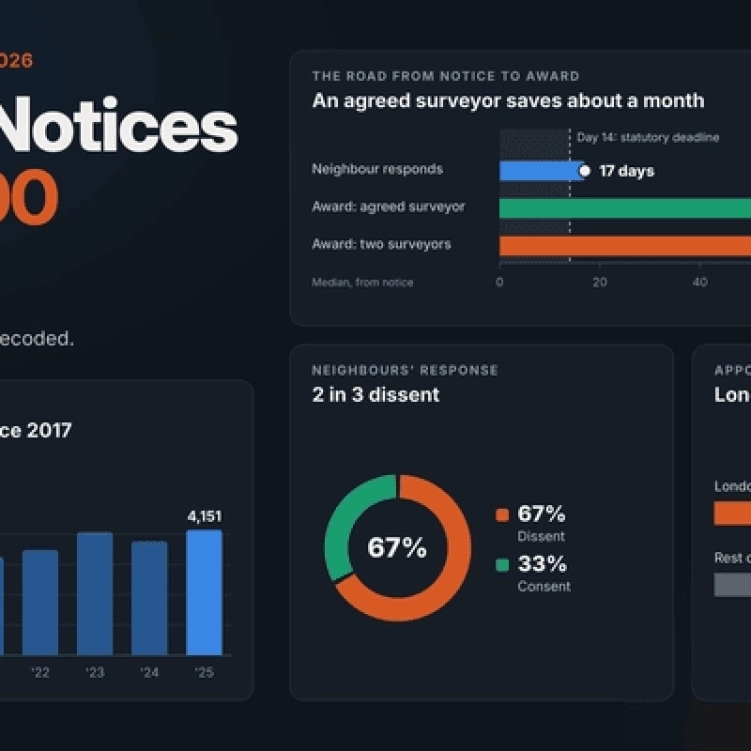
All right. So so I’ve got my notes here because there’s there’s numbers everywhere. So so I’m using AI too much, so I can’t even remember anything already. And so so I so I looked at a a few things. And so the first thing was was the the how neighbors respond nowadays and how it has changed since so we ran it through from January 17 to no, it’s from June 17 to June uh 26, so nine years. We went through 30,000 notices, 9,000 awards, and and had a had a look at at all that. So in terms of how neighbors respond, you still have, and that might not be news to to most party war surveyors, a third of them consent, and two-thirds still dissent.
Nina Young: 26:25
So can you just explain for some of the listeners what that means? Okay, yes, people like.
Philippe Weyland: 26:29
So understand. So when a building owner does work, they have to notify their neighbors. And some, depending on the section, some some some of the neighbors need to then either consent to the work saying, I’m fine, you go ahead, no worries, or they can dissent to the works, which means I need to be represented by a surveyor to make sure that everything is actually respected. Um, sorry, under the party wall, the party wall act, it falls under the party wall act, and then we follow the due process. So you can consent, uh, sorry, dissent and appoint your own surveyor. So you have your own surveyor, and then the building owner has his own surveyor, and they deal the two of them. And or you can dissent and appoint a joint surveyor, which is called an agreed surveyor, which is usually the building owner’s surveyor. And so you have only one surveyor that represents both parties, and and they the surveyor needs to act impartially. Yeah, so and and so that’s that’s the thing. So the notice that you send out, ask the neighbor, do you consent, do you dissent, if you dissent, do you want to appoint the agreed surveyor or your own surveyor? And so this is what we can track because it’s all getting logged into the software. So a third of the people that’s that’s really taken the broad approach of all the regions and and uh depending on if it’s a private owner or um or corporation. A third consent and the two-thirds dissent. So that’s good news for the profession because a consent, obviously, you’re like, well, okay, it’s done. It’s just one police surveyor in the in the process. Yeah, yeah. And and it’s it yeah, it puts an end to to the process. They still they still are protected under the act, but you don’t have to to do the award and uh and and negotiate that. So so the important thing here is is actually the dissent, what type of dissent is it? So 35% appoint an agreed surveyor, and 65% appoint two surveyors. So again, good news for the profession because you have more more surveyors uh involved. However, the agreed surveyor is really the kind of the sweet spot. Why? Because if you’re appointed as agreed surveyor, you don’t have to deal with any other surveyor. And and we did mention the the litigious approach of most surveyors. So when you’re on your own, it’s much easier, much smoother, and much, much quicker.
Nina Young: 29:02
And that’s I’m gonna say the quicker thing, that makes sense, doesn’t it?
Philippe Weyland: 29:05
Less people involved. So and the quicker it is, the happier the your owner will be, obviously. And so timing-wise, so that’s another thing. So you send the notices, and I was there because my neighbor did works, I had the notice sitting on my kitchen table for ages, and and I was like, Oh, maybe I should I should respond. But it was just because it was paper, you had to tick boxes and stuff and then post it or go see him. I thought, I thought, well, can you not do this online? It’d be so much easier. And so so that’s what so we we developed an online acknowledgement form, and that that was actually really cool. But that the timing is important because a lot of people, a lot of uh surveyors told me the problem is is just chasing these adjoining owners, finally getting a response, and to try and and avoid getting to the 104b appointment, try to get get them engaged. And and so timing still so you could see that 60 do respond on time, which is which is quite good. And from the code of the 40% that don’t respond on time, after the notices, if you haven’t responded, you need to send like a what it’s called a 10-day letter. Tell them if in 10 days they haven’t responded, the building owner will appoint a survey on their behalf under 10.4B. And so once you send that letter out, like the majority respond within those 10 days.
Speaker 2: 30:35
I see.
Philippe Weyland: 30:35
So it shows the importance of actually sending that letter on time and and so being on the case. So yeah, that’s the problem with if not, if if you don’t track it properly, you just fall behind. So that’s that’s that’s an interesting one. And so the more interesting thing now is who actually dissents. So you have obviously different types of neighbors. You have your private uh leaseholders, private freeholders, and then you’ve got the companies, company leaseholders and company freeholders. And it’s very different when you look through them, how they respond and whether they dissent or not. So the private freeholder, who’s you and me, and and you get a notice, there’s a 30% chance that they will dissent and appoint their own surveyor. So I’m focusing on appointing the their own surveyor. Why? Because it makes it more expensive for the the building owner and it it usually uh drags out uh longer. The private leaseholder, because it’s not it’s not sometimes it’s not their apartment or anything.
Nina Young: 31:38
So this is like a rented flat or something. More, yeah, yeah. Yeah.
Philippe Weyland: 31:42
Obviously more wary. So so they there’s a 43% chance of them appointing their their own surveyor. But now when you look at companies, it really changes. So the company freeholder, there’s a 60% chance, so double the private owner. And if it’s a company that is a leaseholder, 70% of the cases they will appoint their um their own surveyor. So a tip for surveyors: if you
Philippe Weyland: 32:10
want to do more adjoining owner work, talk to these businesses that have leasehold all over the country. So you’re looking at what kind of high street banks, looking at boots, you’re looking at all these shops, because it’s a it’s kind of an inflow of work that is adjoining owner work, which is usually a bit more relaxed and you charge by the hour. And and so so that’s just from that piece of data, it’s actually quite cool. Some people already know this for sure, uh, but I thought, you know, I’ll put it up.
Nina Young: 32:41
The data supports it, you know, because some of it’s here, so yeah, just experience.
Philippe Weyland: 32:44
Yeah. And so so that’s that was looking at the adjoining owners, so the neighbors.
Speaker 2: 32:49
Yeah.
Philippe Weyland: 32:49
But when a building owner is a company, so the consent rate drops to 10%. So so as soon as you get a notice from, oh, it’s Coca-Cola Limited, you know what? I’m just gonna appoint my own surveyor because they can afford it. I don’t care. So that’s when they they go. So if so, meaning the developers are are dealing with more and more friction because people know about it and say, you know what, I’ll just appoint my own surveyor, it’s all paid for.
Speaker 2: 33:17
Okay.
Philippe Weyland: 33:18
Um, so it gives you kind of a profile of of your your job and how long and difficult it might be when you when you look at those things. And lastly, geography, obviously, London. You’ll have 47% of Londoners appoint their own surveyors against 26% outside of the M25. Interesting. And and this is why the you know the party war world is really within within the M25. That’s that’s where most of the jobs come from. So another thing is because we can see the life of a job from the day they issue the notices until the award is agreed. Because the award is the last last bit of the puzzle. Is it’s an agreement between the two parties on how the works are going to be conducted. Yeah. That’s all the details. Okay, you’re gonna be working from nine to five with a break there. Are you gonna put scaffoldings there?
Nina Young: 34:15
The actual practical operational, this is actually what’s gonna happen. We’ve agreed to that, yeah.
Philippe Weyland: 34:20
So that’s what surveyors need to come to. We sign an award, and then you can go on with the works. Although in my case, we signed the award three months after the works had already started. But I I I I got on really well with my neighbor, so I didn’t really care. And and and so so we can look at this average dispute resolution because the party wall process is a dispute resolution mechanism, right? Yeah, and so uh this is really how how we should look at uh the efficiency of party wall surveyors. How long does it take you to get from notice to award? And the shorter the better.
Nina Young: 35:02
Yes.
Philippe Weyland: 35:02
And so so we can look at that. And so the average day or the average number of days from notice to award is 73 days. 73 days, that’s why there’s two and a half months.
Nina Young: 35:14
Wow.
Philippe Weyland: 35:15
So it is it is quite big because when you think about you know a party war, yeah, it’s just two week things, just and that’s the average, and that feels quite long. Yeah, yeah. And so when you drill further into, so this, yeah, so this is two surveyor award and agreed surveyor award combined. Okay, it’s the average combined. But when you look at now the difference between agreed surveyor award and two surveyor award, you have a six-week gap between the two. So it’s six weeks shorter on average to have an agreed surveyor award. Why? Because, well, you don’t have to to deal with slop grenades from the other, the other surveyor. So this is really crucial. So if you can, as as a party war surveyor, when you when you look, it’s probably it’s mostly residential stuff, have your building owner go talk to his neighbors and try to appoint one surveyor, you you you’re just shortening the life of a job by six weeks. So meaning, meaning you can take on so much more.
Nina Young: 36:17
And it’s so much better for the for the client. It’s so much better for the yeah, for everyone.
Philippe Weyland: 36:21
For everybody, so much cheaper.
Nina Young: 36:24
Yeah.
Philippe Weyland: 36:25
And so so it’s it’s trying to figure out how to do that, how to implement that process of trying to get neighbors to to agree on on a joint surveyor. So so and that’s really because I I had to look at it again. I was like, six weeks, that’s just insane. That’s massive. So and then I looked at okay, so what are the are the things that slow down the award? So you got four things, which is the type of building owner, which I mentioned earlier. So if the building owner is a company, you’ve got less consents, you’ve got people appointing their own surveyor, so that takes longer. The type of AO. So if it’s a company leaseholder, that’s a red flag. So it’s AO, sorry.
Speaker 2: 37:07
AO.
Philippe Weyland: 37:07
So adjoining owner, sorry, adjoining owner, so meaning that’s the that’s the neighbors. Got it, got it. Yeah, so it’s building owner and then adjoining owner. So the lingo. And then the number of adjoining owners. So, you know, if it’s just um a loft conversion, you might have two two neighbors, like very quick and and easy. But as soon as you go over the five adjoining owners, so five neighbors threshold, the timeline doubles.
Nina Young: 37:36
Wow.
Philippe Weyland: 37:37
Yeah. Well, because you have so yeah, you’ve got so much more to do, right? And and you you have jobs with hundreds of adjoining owners.
Nina Young: 37:46
So these like, would this be like an apartment block or something?
Philippe Weyland: 37:49
Or yeah, yeah. Or if you or if you dig, if you start digging and and the other properties are three to six meters away. Okay. And then then you have you have more more more headaches.
Nina Young: 38:02
And it becomes more So more basically, more people in the pot. It’s like they say too many cooks spoil the broth, is the is a is a phrase. So you got uh as soon as you get lots of people involved, whether it be two surveyors, one surveyor, or more people, it’s gonna cause a lot more headaches and a lot more time.
Philippe Weyland: 38:18
Yeah, exactly. But it’s funny that they have that five, there’s there’s that five five adjoining under five neighbor threshold. And then there’s also types of notices, but I didn’t I didn’t I didn’t wanna and the location, right? Like I mentioned, London adds adds an average of five weeks to your job whenever you’re in London in general. So because it’s more contentious, because they send appoint their own their own surveyors and all that. But having said that, if you look at the data from 2016 and today, or 1217 and today, the average time from notice toward has
Philippe Weyland: 38:55
dropped by 20 days. And this is because, yeah, I think surveyors are starting to use more systems. Obviously, this is the data from our users. So we’ve developed, we developed some tools to actually speed up the process, and so that’s quite nice because I can see it’s working.
Nina Young: 39:13
You can see it demonstrate that, yeah.
Philippe Weyland: 39:14
Yeah, and so the the last thing is seasonality as well. So you can see peaks and troughs. So peaks in March of the number of notices issued, which kind of makes sense because it’s spring, it’s before you’re going to the summer for the works to start early. And then December is the lowest month by 40%. So December, everyone is out. Christmas partying, Christmas party, yeah. But it it gives you a good, a good kind of idea of how to do your marketing. So if you start doing your marketing from November to February, for example, spend more time there talking to your architects, your builders, and stuff because it’s slower. And and also another thing, January. Uh notices issued in January get to the award stage much quicker. So that’s the kind of the quickest month. And it’s probably why because it was so quiet in December that January, everything, everyone’s back to work, everyone’s getting it done. Getting the work before so before the March rush, because if you issue notices in March, it will get longer. So your your notice to award, so your your job will actually take longer, and that’s super interesting. So try to get your owners to agree on on sending notices out in January. Easily instead of waiting February or March.
Nina Young: 40:36
See, this is a really good example of, and this is such a good example of using AI and what it can, the insights it can bring when you have that amazing data. I mean, it’s it’s telling you so many things. And then you can use that data to then share that wider and also with clients. I mean, these tips are incredible because they’re coming from actual, you know, sources of data and truth as opposed to just hearsay and anecdotal. Yeah, exactly. And I think it’s just it’s such a great example. And this and and like we were discussing, there’s so many things you can do with this data, and and but it’s a win-win, and it’s it’s it’s kind of demonstrating interesting things of of psychology and you know, getting more people involved makes it much longer.
Philippe Weyland: 41:22
But so so this is why. So I I was so sorry, you can see I get it really excited. So so this is this is exactly the question I asked it. I was like, okay, so now having looked at all this data, yeah, can you give me some tips that could be useful to party walls of this? And and so so so the the the first one, so I mentioned a couple already, but it’s it’s to price price per risk profile. So this is in when a job comes in and you know the BO is a company, the building owner is a company, you’re in London, you can see that you have two company leaseholders, for example, you’ve got more than five adjoining owners, you know that this job is going to take you what 170 days or something. Yeah so price accordingly. And so that your tougher, longer jobs don’t eat into the margin of the smaller, quicker ones. And that’s super is super interesting because you’ve super valuable. Um you’ve got those things, and I I don’t know if people do that. I I think with enough enough experience, you probably know. But for the younger guys, the younger generation, they get a big job, they’ll be like, Well, I’m I’m taking this, but it’s going to take them six months and and it’s going to destroy them physically, mentally, and financially.
Nina Young: 42:41
Yes, because yes, because one one of the things that because it’s coming towards the the end of the of the show today, but one of the things that you mentioned contentious in party wall. Can you sort of just share a little bit more about that? Because obviously, you know, on the show we have different types of surveying. What is what is it about party wall that makes it so contentious?
Philippe Weyland: 43:02
Well, they’re acting in a quasi-judicial role. So it makes it more more what? I think it creates an underlying tension. So they would they they want to do it properly. So whenever some someone does it does the wrong thing, it’s straight up like, oh, I need to show that I know my stuff.
Speaker 2: 43:18
Yeah.
Philippe Weyland: 43:19
And it’s it’s the back and forth, the continuous and also it’s a very small niche market. You’ve got what 1500 people. And so they all know each other. That’s very and and so it’s it’s kind of, yeah, you don’t want to be too be criticized by your peers. And if you do, you you I think you get again the ego gets in the way.
Speaker 2: 43:44
Yeah.
Philippe Weyland: 43:45
And and so so I don’t know if we talked about it about this before recording or not. This this customer of mine who said, Yeah, can you develop a functionality that that that can so I I can I can write next to the name of a surveyor that was on the other side. Whether they’re difficult or not, so I can I can try to accordingly red amber green.
Nina Young: 44:06
Oh but there’s a dial. Oh no. This is gonna be a nightmare job.
Philippe Weyland: 44:11
And it’s it’s it’s sad that it’s come to that. Last week I had a conversation with a customer uh who cancelled. Why?
Philippe Weyland: 44:20
Because he he’d had enough, had enough of it. Uh it had too much of an impact on his mental well-being because it was so contentious. And uh and that’s that’s a sad sad state of Yeah, it is.
Nina Young: 44:32
It’s very emotive though. I mean, I have come across this from Party World Surveyors that I’ve just got out of it because it’s like it’s too much. And especially when you especially also from sort of the personal side, so you your homeowners, that is so emotive. I mean, some of the stories I’ve heard on that where someone simply wants to, I don’t know, something to do with a f- it could be a fence or someone has to remove a tree. There’s a story I heard, which was where there was adjoining owners, and they this tree was overhanging from the other side, and it was, you know, encroaching, and they needed to do something to do dig down into the foundations, and it was going to affect this tree next door and the roots. And they had so much resistance about this tree, and it went on and on and on and on. And it wasn’t until the surveyor went actually round to the property, and there’s this elderly lady, and basically that tree was planted because her son had died, and she planted it because of him, and that is why. And then the she got the other the joining owners to come round. They had a conversation and then they just sorted it out. And this had gone on for months, and that was such a I’ve never forgotten that story of how getting people to communicate and talk to each other makes such a difference.
Philippe Weyland: 45:53
That’s an amazing story. Yeah, yeah, it’s all about communication. And this this that the act cannot you you you can’t you can’t put another another another section in the act telling people to communicate better. And and and this is I think this is where you can see that certain party war surveyors are doing very well is just because they take the time to talk.
Nina Young: 46:15
I think it’s it’s crucial, it’s a crucial thing that’s underestimated and undervalued. And I think and and what you’re demonstrating also with the with the data is that the importance of communication. I always think of that situation where you’re stuck in a motorway in a traffic jam, and immediately your stress level is like you’re stuck and you want to know why. You want to know why, and then something comes up on the on the on the motorway banner, like object in the road or people in the road, or you suddenly know there’s there’s an accident, and you’re like, you do relax a little bit because like I don’t know, I know now. And it’s like that stress is such a good example of how people just need to know what’s happening, and then it does affect how they they’ll wait another week, they’ll wait another two weeks because they realise that oh right, okay. Not necessarily happy about it, but at least I know why.
Philippe Weyland: 47:01
Yeah. But you can’t you can’t have AI do that either. No, that’s not going to happen. No, you’ve got automate kind of calls and stuff.
Nina Young: 47:10
No, and I think that’s it. This is a really good example of how in the in the age of AI that this this that kind of thing is just is the where the value will always remain with people dull to people and how it just reduces stress and worry and and things like that. Before we wrap up for today, is there anything else you want to share before we before we close off? No. We’ve covered some good ground for these. No, I’ve really enjoyed this chat. Yeah, I have.
Nina Young: 47:35
It’s the it’s it’s been an array of things as well. You know, you know, in some ways, some people could view party wall surveying as quite dry, but I I don’t think it’s dry. Because of because of the like you say, the contentiousness of it, the animosity of it, and also the things that I I hear from things that happen out there with practices and and some there’s some bad practices out there where people are pushing to get two surveyors involved because they know it there’s more money, there’s more money to be had. But is that the best outcome for clients and things? No, no, it’s not. As you’ve demonstrated, it takes longer and it’s more stressful.
Philippe Weyland: 48:14
Yeah, but it’s funny, it’s funny when you when you mentioned contentiousness because I I stuck with that market. Why? Because I thought the the people, particular surveyors themselves, are actually really good guys. Yes. Um, I’ve always enjoyed my conversations with them. I’ve had beers with them and stuff, and it’s uh it’s a good bunch of people. And I think they they just flick that switch when they’re like, okay, I’m in I’m in surveyor mode now. I’m in surveyor mode. They can get a bit carried away, I guess.
Nina Young: 48:41
It’s true, and I think that’s that’s very typical of of of most surveyors, to be fair. I think that’s the same thing. I think it’s the the very common characteristics and psychology and you know, need for communication skills is across the board. But I’ve I’ve really enjoyed this conversation, Philippe, and some of the insights that you have given will make sure that as many well, anyone listens to it, but there’s many particles surveyors because you’ve got some really good insights and tips there, I think they can take away from this. And it also goes to demonstrate the importance of data and software and the value that it will bring. And it’s not just a case of always saving time, it’s providing this kind of insight, which you wouldn’t get. You’ve got you’ve got what nearly a decade of of data that you’re working on. Yeah. So what we’ll do is in the show notes, I include links to you on Party War Pro, uh LinkedIn, and also details around contact details for this report, which I’m looking forward to. We’ll make sure it gets shared.
Philippe Weyland: 49:40
Okay. We can we can also share with your members if you’re we definitely will.
Nina Young: 49:45
We definitely
Nina Young: 49:45
will. But thank you very much for today, Philippe. I’ve really I’ve really enjoyed it.
Philippe Weyland: 49:49
Thank you. Thanks, Nia.
Nina Young: 49:50
Thank you.
Philippe Weyland: 49:51
So did I. Thanks.
Nina Young: 49:52
Thank you for listening to This Is Surveying. If you enjoyed this episode, please subscribe and leave a review. It really helps more people discover the podcast and supports the work we’re doing to raise awareness of the profession. You can also join the Surveying Room, the free and independent community from Surveyed UK, bringing surveyors together, breaking down silos, and of course making surveying visible. Just head over to surveyors-uk.com to learn more and join today. All the links discussed in today’s episode are included in the show notes.

Philippe Weyland
Co‑founder of Party Wall Pro