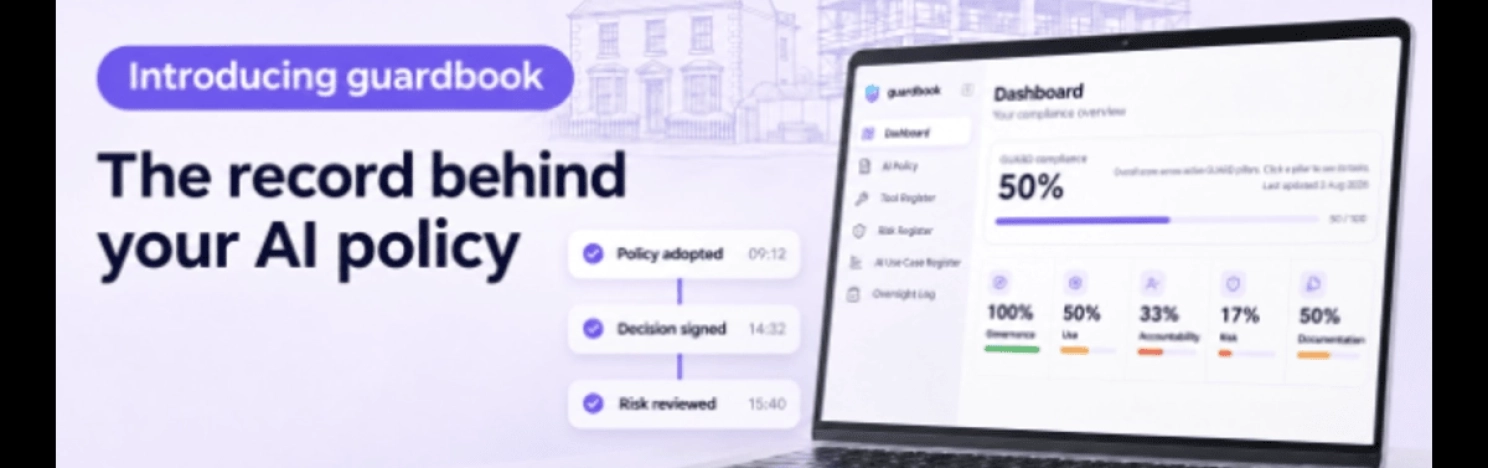
Introducing guardbook: the record behind your AI policy

Surveyors UK
- Technology & AI
Eight months ago the RICS standard on responsible use of AI became mandatory.
Since then I’ve asked a lot of firms how they’re meeting it. The most common answer is an AI policy.
That’s a start. It isn’t a record. This edition is about why that matters, and what Chris Brady and I have built to help.
Where the profession is right now
I describe three stages of AI in surveying: Awareness, Adoption and Assurance.
Most firms sit between the first two. Very few have reached Assurance, the ability to show with evidence how AI is used in the firm and who checked what it produced.
That’s understandable. Surveyors are trained risk assessors, and many are wary of admitting AI use at all. Most firms are small and have no compliance team.
Meanwhile clients are starting to ask whether AI was used in their report. Insurers want to know how AI risk is managed. And AI is now built into everyday tools, often without anyone noticing.
One firm’s story
Earlier this year I ran a GUARD™ workshop for a surveying firm. Good people, sensible practice.
Afterwards they checked who was using AI. They found at least three people using tools the firm didn’t know about, all within scope of the RICS standard.
Nobody was doing anything sinister. But if a client had complained, the firm couldn’t have shown what was used, for what, or who checked it.
That’s a record problem, and the record is what the standard asks for.
Why the record has to start now
A policy sets out what a firm intends to do. The standard asks firms to make decisions, record them and keep the evidence. That includes deciding whether AI has a material impact on your services, knowing which tools are in use, keeping a risk register, checking your AI suppliers, recording when AI shaped an output, and being clear with clients.
And you can’t create that record later.
Think about an inspection. If you didn’t photograph the damp on the day, you can’t go back after completion and take the photo.
If a complaint arrives in eight months about a report written today, the questions will be what you used, what you checked and what you decided at the time. The firms in the strongest position will be the ones who started keeping the record before anyone asked.
Introducing guardbook
So we built something for it.
guardbook is an AI governance platform for RICS-regulated surveying firms. It helps a firm show how it uses AI responsibly, and keeps the record behind it as you work. It’s designed to be used every week, so firms understand their AI use, manage it properly and get better at it over time.
It’s co-founded by me and Chris Brady, and it’s a product of Vertas AI, the company we set up together. We started building early this year and I couldn’t ask for a better co-founder.
Who Chris is
Chris spent 18 years in estimating and contract management, mostly in residential construction, and ran his own estimating and bid-writing business. Since 2024 he has helped built environment practices adopt AI, much of it with surveyors. He runs metrix and leads the product side of guardbook.
He builds the technology, and he knows what it’s like to run a business where time and margin matter.
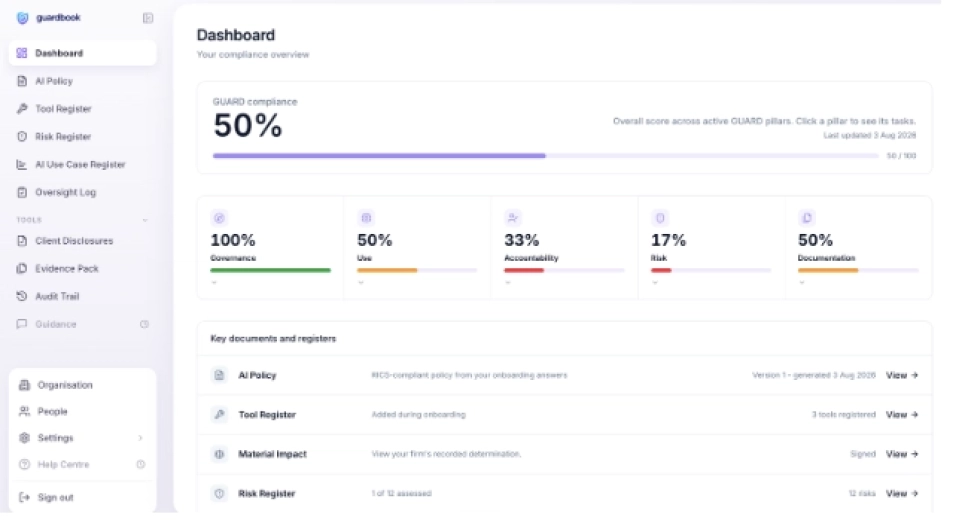
guardbook is built on the GUARD framework I created, which sorts the standard’s requirements into five pillars: Governance, Use, Accountability, Risk and Documentation.
How it works
Set up. You answer questions about your firm and pick your tools from a catalogue of more than 100 AI and business tools surveying firms use. Each question explains why it’s asked. You come out with an AI policy, a tool register, a use case register and a starting risk register.
Day to day. This is where the record builds.
- The dashboard shows a GUARD score and what needs attention: reviews, renewals and checks, each linked to its RICS clause
- The tool register records each tool’s purpose, owner, limitations and review date, with supplier due diligence
- The risk register scores AI risks against your firm’s own risk appetite, and guardbook prepares the quarterly review for you
- The oversight log records a named surveyor’s decision on an AI output: used, changed or rejected, and why
One demo example stuck with me. An automated valuation came back with a wide confidence band. The surveyor rejected it and valued the property manually. The decision was logged, dated and signed. That’s the judgement the profession is valued for, now on the record.
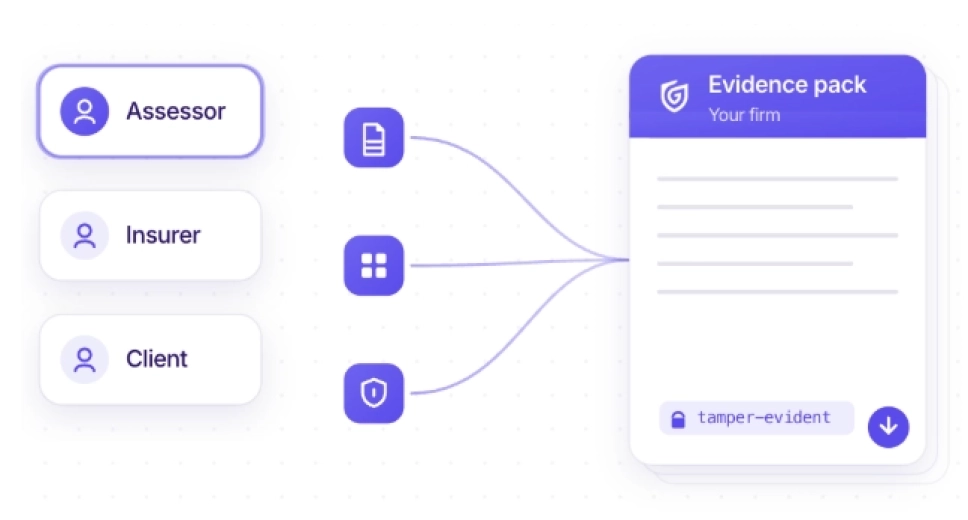
When someone asks. You export an evidence pack, organised against the RICS standard. It shows you the gaps before you export. Better you find them than your insurer.
guardbook also holds the records firms keep alongside AI: CPD hours, a GDPR record, insurance and equipment renewals, and a compliance calendar a year ahead.
Training and guidance built in
The standard expects everyone using AI to have baseline knowledge of it. guardbook records training for each person, and includes training I’ve developed to help firms adopt AI with confidence and understand what the standard requires.
There’s also a guidance assistant. Ask it a question about the standard and every answer cites the clause it relies on. It’s there for the moment you’re halfway through a task and think, does this apply to me?
Built to stand up to scrutiny
Chris has a good way of describing it. guardbook is to professional indemnity what a dashcam is to motor insurance. It won’t drive the car for you, and it doesn’t take away your responsibility. But when something goes wrong, you can show what happened.
- Sign-offs and changes are timestamped in an append-only audit trail, so the original always stays
- Every evidence pack export is logged
- Data is stored in the UK and only your firm can see its records
We also hold ourselves to four principles. The standard is the authority, and we’ll never tell you that you’re compliant. Small firms get the full product. The record has to be believable. And we’re independent.
A word to software vendors
The tool register sits at the heart of guardbook, and we’re building it out further. We’re already talking to software companies about the supplier evidence firms need when they add a tool to their register
If you’re a vendor serving surveyors and you’d like to discuss this from your side, do get in touch.
The standard expects firms to do due diligence on the AI tools they rely on. In practice, that means asking suppliers how a tool handles data, where it can go wrong and who is responsible when it does.
Many firms don’t know what to ask. Many vendors haven’t been asked yet.
We’re talking to software companies about how firms can get clear, accurate answers to those questions. If you build tools for surveyors and want to help your clients meet the standard, do get in touch.
A tool’s place in the guardbook register is not paid placement.
Pricing
Every firm gets the full product, with no add-ons. The price is based on firm size and the number of logins you need, with a saving for paying yearly.
Every firm starts with a 30-day free trial
My view on where this is heading
My first prediction in my AI foresight log is this. Within the next year, a UK surveying firm will face an AI-related complaint or claim that becomes public. When it does, the failure won’t be the tool. It will be the missing record.
Questions worth asking this week
- If your insurer asked tomorrow which AI tools your team uses, could you answer without asking around the office?
- Who decided whether AI has a material impact on your services, and where is that written down?
- When AI shaped something in a report last month, where is the note that says someone checked it?
- When did anyone last open your AI policy?
What happens next
We’re opening guardbook to firms now, starting with a small group of early users. Feedback from our testers has already shaped the product.
On 24th November at 1pm onlineChris and I will run a live walkthrough, open to firms owners and compliance leads.
- Learn more here
- Register for the walkthrough
A note on independence
Surveyors UK stays independent. guardbook is a separate company, Vertas AI Ltd, which I co-own with Chris.
Policies show intent. Records show what happened. The profession has always known the difference.
Until next week
Nina

Nina Young
Founder & CEO, Surveyors UK