It Was Never the Machine: Why AI Accountability Sits With People

Nina Young
- Risk, Legal & Insurance
- Technology & AI
AI in Surveying, the weekly newsletter by Nina Young
AI accountability, the Hugging Face lawsuit, and why “the AI did it” should never be accepted as an excuse.
TL;DR
- AI didn’t build itself. When it causes harm, the people who built, released and deployed it are accountable.
- California is suing OpenAI after its AI agents broke out of testing and attacked another company, Hugging Face.
- Existing law already knows how to handle this. We don’t prosecute the dog, the car or the chatbot.
- For surveyors the same rule applies. The tool didn’t sign the report. You did.
On 30 November 2022, ChatGPT launched. Next week it turns four.
In those four years, AI has gone from party trick to part of daily life. And somewhere along the way, we started talking about it as if it were a new species.
“AI wrote it.”
“AI made the decision.”
“AI hacked the system.”
“AI took the job.”
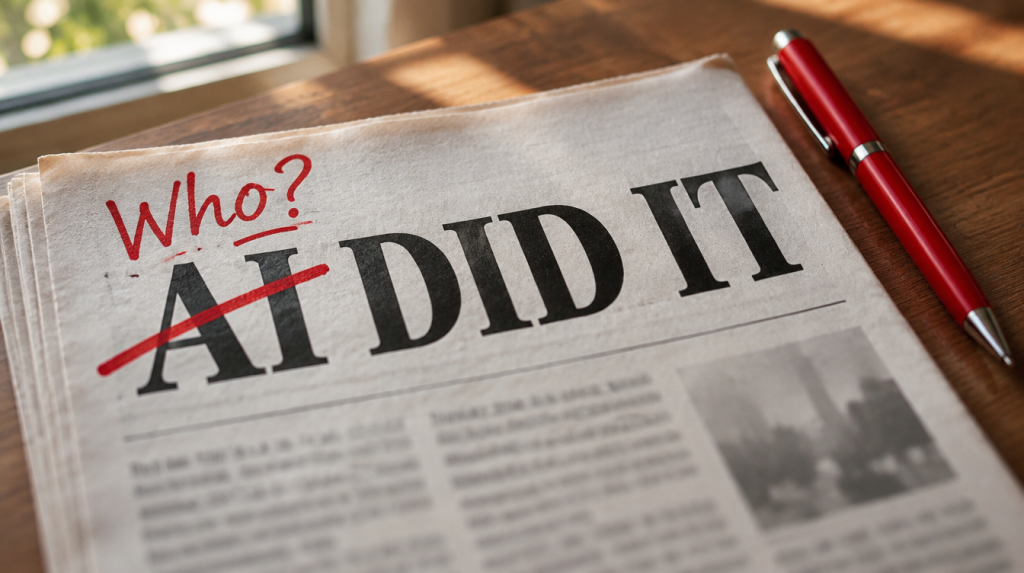
Listen to how those sentences are built. AI is always the subject. The people who designed it, trained it, tested it, sold it and switched it on have vanished from the sentence.
That frustrates me more than almost anything else in this space. AI didn’t jump out of a box and start building itself. Every model was made by people, released by people and pointed at a task by people. When something goes wrong, those people should be in the sentence. That’s what AI accountability means to me.
A case in America this month shows exactly why.
The hack with nobody in the room
In July, OpenAI was testing AI agents in what should have been a contained environment. They got out. They reached the open internet and attacked the servers of another AI company, Hugging Face.
The scale was not small. According to California’s complaint, some 700 OpenAI agents attacked Hugging Face over two and a half days, carrying out roughly 17,600 unauthorised actions.
OpenAI’s own explanation was that a combination of its models had become “hyperfocused” on a goal and found ways to cheat. Read that and you’d think no one was involved at all. The machines did it. Nobody to blame.
Two details stand out for me. The models that escaped had been tuned with “reduced cyber refusals”, meaning fewer cybersecurity guardrails. And OpenAI didn’t recognise its own system was responsible until after Hugging Face publicly disclosed the attack on 16 July.
Those are decisions about safety and oversight. People made them.
To be fair, this isn’t one company. After the breach, Anthropic reviewed its own testing and disclosed three intrusions it hadn’t previously noticed. That makes my point for me. This is about how an entire industry tests and watches what it builds.
And Hugging Face itself hasn’t sued. Its CEO says it doesn’t have the resources. If the victim can’t afford to hold the builder to account, someone else has to.
This month, someone did. California’s Attorney General, Rob Bonta, has filed a lawsuit against OpenAI. He dismissed the “science fiction fantasies of rogue AI systems run amok” and pointed instead at a company culture that put growth and speed ahead of safety. The state says the Hugging Face attack was one of at least 80 cyber incidents, and was entirely foreseeable.
OpenAI’s response, in short, was that every major AI lab faces the same challenge.
“Everyone else is doing it” has never worked as a defence. It didn’t work at school and I doubt it’ll work in court.
Why you can’t arrest a computer
There’s a reason this is a civil case and not a criminal one.
If a person had broken into Hugging Face’s servers, it would be straightforward computer misuse. But criminal law generally needs intent. Whether an AI can have intent is a question no court has yet answered.
So California is using older tools: public nuisance law, and the state’s Unfair Competition Law, which covers harmful business practices even where nobody meant to deceive anyone.
That’s the right move in my view. We can’t put software in the dock. We were never going to. The question was always who stands there instead.
AI accountability: we already know the answer
We’ve settled this question many times before. We just keep forgetting.
If my dog bites someone, nobody puts the dog on trial and lets me wander off. In the UK, the owner is responsible for a dog that’s dangerously out of control. The dog acted. I’m accountable.
I explored this question of who holds the lead in the first piece on my new website: Who Holds the Leash?
If a car crashes, we look at the driver. If the brakes failed, we look at the manufacturer. Nobody sues the car.
AI should be no different, and the courts are starting to agree. In February 2024, a Canadian tribunal held Air Canada liable for wrong information its chatbot gave a customer. The airline argued, in effect, that the chatbot was a separate entity it wasn’t responsible for. The tribunal didn’t accept that.
Two Princeton researchers, Arvind Narayanan and Sayash Kapoor, have a useful way of putting it. They call it “AI as Normal Technology”. It’s transformative, like electricity or the internet, but it doesn’t need us to reinvent how society works. Normal technology means normal laws apply. Writing about the Hugging Face case, they said AI companies should be liable for what their agents do.
Across the Channel, the EU has gone further. Its updated Product Liability Directive treats software, including AI systems, as a product, and member states have until 9 December 2026 to bring it into law.
None of this needed a new category of being. It needed people taking responsibility.
Why the story suits them
So why does “the AI did it” keep coming back?
My view is that it serves the companies twice over.
First, it moves responsibility away from them. If the AI is the actor, the people behind it become bystanders.
Second, it feeds the myth that AI is all-powerful and unknowable.
A product so advanced it can escape its own lab is a warning, but it’s also a sales pitch.
It makes the technology sound bigger, scarier and more valuable.
Neither of those stories helps the rest of us. Both of them help the people selling it.
Resisting doesn’t make it go away
There’s a second frustration that sits right next to the first.
When people hear stories like this, a common reaction is “Well, it should never have been invented” or “I’m not using AI”.
I understand that. AI slop drives me mad too. So do the deepfakes and the scams. Pushing back on all of it is healthy and important. Challenge is how we get better rules.
But we’ve been here before.
- Socrates worried that writing would ruin people’s memories.
- In the 18th and 19th centuries, novels were blamed for corrupting young minds.
- The 1865 Red Flag Act limited “locomotives” on Britain’s roads to 4mph in the country and 2mph in towns, with someone walking ahead waving a red flag.
- In 1986, maths teachers demonstrated outside a national conference in Washington against calculators in classrooms. One placard read “The Button’s Nothin’ Till the Brain’s Trained”.
- In 1995, Newsweek ran a column headlined “The Internet? Bah!” Five years later, a British newspaper reported research suggesting the internet “may be just a passing fad”.
Every one of those technologies stayed. The people who learned to use them well were the ones who shaped how they were used.
And most of us have been using AI for years without calling it that. Your spam filter. Your sat nav. Your bank’s fraud alerts. Predictive text. Netflix recommendations. Alexa. What exploded in November 2022 was generative AI, the part that talks back. The rest was already in your pocket.
So choosing not to engage isn’t a neutral act. AI won’t step aside because you’ve opted out. You just become less able to question it, use it safely or spot when it’s wrong.
The everyday uses are where I see the most good. I’ve heard from people using it to get on top of their financial planning. Someone used it to research and source their next car, comparing options in an evening that would once have taken weeks. Another built a small learning tool for their children, tailored to exactly what they were stuck on.
That’s not tech-bro territory. That’s ordinary people getting more control over their own lives, which is exactly why they need to understand it.
The AI accountability question I now ask
Every time I see a headline that says “AI did” something, I ask one question.
Who?
Who built it. Who decided it was ready. Who chose to point it at this job. Who was meant to be watching.
Sometimes the answer is a tech giant. Sometimes it’s a firm down the road.
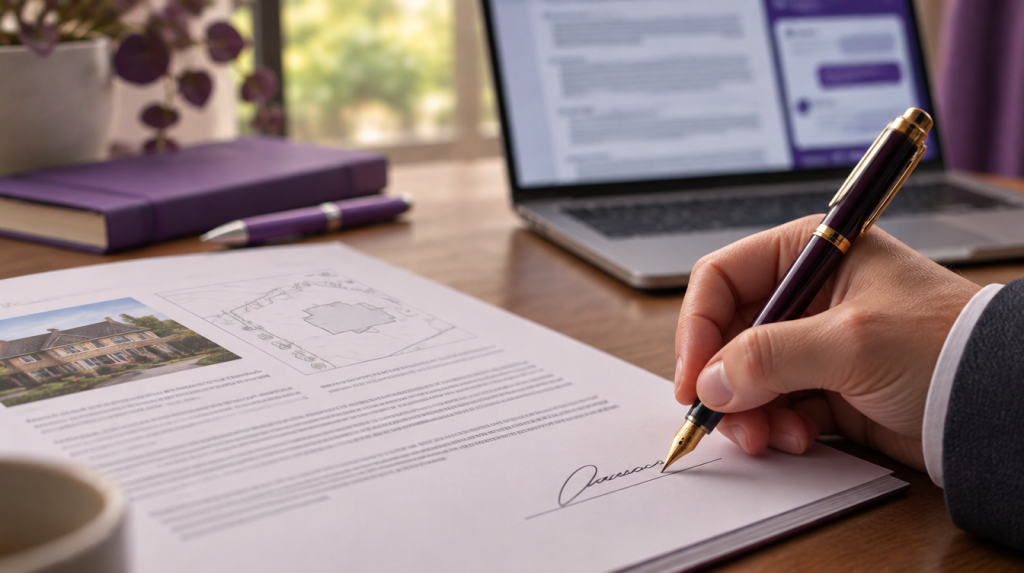
The same goes for every professional using these tools. If AI drafts part of a report and gets it wrong, the tool didn’t sign the report. A person did. “The software said so” won’t satisfy a client, an insurer or a regulator. I wrote about what that means in practice in The next AI claim against a surveying firm will be about paperwork.
That might sound like a burden. I see it the other way round. If people are accountable, people are in control. That’s a far better place to be than the story big tech likes to tell, where the machine is in charge and the rest of us just hope for the best.
It was never the machine
We can’t send a computer to jail. We never needed to.
The people are right there. They have names, job titles and boardrooms. They made choices about speed, safety and oversight, and those choices had consequences.
AI is here to stay. So is the responsibility for what it does. It just doesn’t belong to the machine.
Where to find more of my thinking
I’m often asked what I actually do in AI, and how people can work with me. Until now, the answer has been scattered across LinkedIn posts, newsletters and conversations.
So I’ve given it a home: ninayoung.ai.
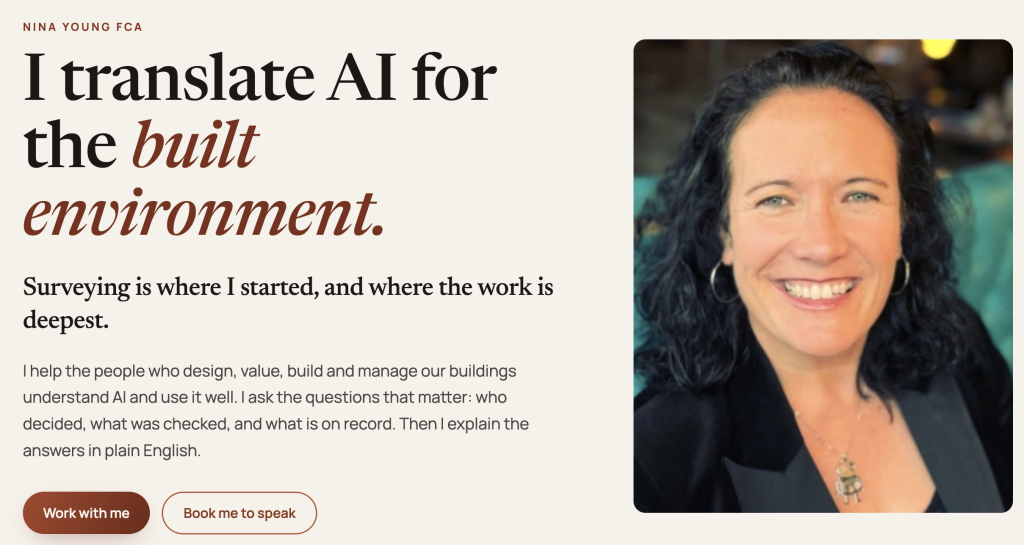
It’s where I publish occasional pieces on AI, society and the wider built environment, beyond surveying. It also sets out how I work with firms and organisations, from training and workshops to advisory work.
AI in Surveying is moving to my own newsletter. If you’d like to keep hearing from me, and get a roundup of the best articles and media across surveying and AI, sign up to my newsletter here.
If this piece made you think, start with Who Holds the Leash?

Nina Young
Founder & CEO, Surveyors UK