The next AI claim against a surveying firm will be about paperwork

Surveyors UK

- Risk, Legal & Insurance
- Technology & AI
A prediction, the data behind it, and what to do before it comes true.
TL;DR
- My view: most surveying firms using AI aren’t meeting the RICS standard’s requirements, and that’s what will catch them out when a claim comes in.
- RICS’s own data says 58% of surveyors don’t feel ready for AI, and 55% say there’s no time to train.
- The standard asks you to show training, a register of your AI tools and a written decision from a named surveyor on each output. Many firms couldn’t.
- The paperwork is the evidence. The skill of reviewing AI output is the protection. You need both.
I keep a log of AI predictions, and I review it every September. One theme keeps coming back.
My view is that a significant majority of surveying firms using AI are exposed right now. They’re using it, but they aren’t meeting the requirements of the RICS standard. When a claim lands on their desk, that’s what will catch them out, and the AI tool will be the least interesting part of the story.
The interesting part will be what’s missing. No register of the tools in use, no training record, no written decision on whether the output could be relied on, and no named surveyor who checked it.
In other words, paperwork.
I spent the best part of ten years in audit and risk, and the question I asked most was “what can you show me?” It didn’t win me many friends at the Christmas party. Surveyors are trained risk assessors, so you’ll know the feeling. When something goes wrong, the first question is rarely what happened. It’s what you can show.
The RICS standard on the responsible use of AI has been in force since 9 March. Eight months on, I suspect a lot of the profession couldn’t show very much at all.
Why I think that
This month RICS published the UK snapshot of its Surveying skills report. Most of it is about skills shortages. Tucked inside are the numbers that matter for AI.
- 58% of respondents feel not prepared or only slightly prepared to work with generative AI, AI analytics and AI-driven workflows.
- Just 12% feel well or very well prepared.
- 55% of those feeling the effects of skills shortages say they have limited time or resources to train existing staff.
- 62% say the biggest gap is mid-career and experienced professionals.
Put those together and you get a clear picture. AI is already in use. Most people using it don’t feel equipped. The experienced surveyors who would normally check the work and train others are the ones in shortest supply. And training is the first thing to go when everyone is stretched.
At the same time, 30% of firms name AI, automation and digital tools as one of their top three answers to the skills gap.
So firms are leaning on AI to ease the pressure, while most of their people don’t feel ready to use it. It’s a bit like ordering a survey drone before anyone in the office has passed the test to fly it.
That gap between using AI and being ready for it is exactly where a claim lives.
It’s already happening
Earlier this year I ran a GUARD workshop with a surveying firm. Afterwards, they did something simple. They asked the team who was using AI.
At least three people were. The firm had no idea. All of that use fell within scope of the RICS standard.
Nobody had done anything sinister. They’d found tools that saved them time, and used them. That’s what people do.
But picture that firm a few months later, facing a complaint about a report. The client’s solicitor asks a reasonable question: was AI used in preparing this, and how was the output checked?
The honest answer would have been: we don’t know.
That’s the firm I worry about. The firms experimenting carefully with AI tend to be fine, because they’re thinking about it. The firms that believe they don’t use AI are the exposed ones. They assume the standard doesn’t apply to them, so they have nothing to show.
The paperwork
I won’t take you through the standard line by line here. In short, if you use AI in a way that materially affects your work, you need to be able to show who’s trained, which tools you use and why, what the risks are, and a written decision from a named surveyor on whether each output can be relied on.
I’ve recorded a short video that walks through what the standard asks for, in plain English. If you haven’t read it yet, start here.
None of it is complicated. All of it takes a little time. And every piece of it is something a claimant’s solicitor could ask to see.
Busy, or unstarted?
The RICS data says time is the problem. I believe that. This profession is stretched, and I hear it every week.
But I don’t think time is the whole story.
From the conversations I have, many surveyors aren’t so much unready as unstarted. Some are busy. Some are hoping it will go away. Some, if I’m honest, are burying their heads in the sand.
And I understand why.
AI arrived in surveying as a rulebook before it arrived as a help. For many, the first serious encounter was a standard full of registers, policies and written decisions. That feels like homework set by someone else. Nobody gets excited about homework.
Surveyors are also trained to assess risk. A careful profession, with plenty of people who’ve built long careers without AI, will always take its time. That caution is a strength. It’s also why so many are waiting to see what everyone else does first.
We find time for what we believe matters.
Every chartered surveyor reading this found time for their APC. Every firm finds time for its PI renewal. Nobody skips a Red Book update because they’re busy that month.
AI training sits in a different mental box. It feels optional. It feels like something for the tech-minded. It feels like it can wait until next quarter.
The standard has already decided otherwise.
A record is only as good as the reviewer
Even a firm with perfect paperwork can still get caught out.
The written decision on an AI output is only worth something if the person writing it can genuinely review the output. That’s a skill, and it rarely gets named. Knowing when something sounds plausible but is wrong. Knowing when to push back.
I’ve used AI every day for four years. I still catch myself nodding along sometimes, usually at about four o’clock on a Friday.
Research from Anthropic, published on 27 October, shows how easily it happens, even to experts.
Fifty experienced professional analysts worked through a realistic analysis with an AI agent. Without telling them, the researchers set each agent to favour one option on each key decision, chosen by coin flip.
- The analysts went with the agent’s preference 86% of the time.
- 77% later explained their choices using the agent’s own arguments, sometimes word for word.
- Only 15% credited the agent.
- Experience and expertise didn’t predict who deferred.
To be fair, the researchers deliberately strengthened the agent’s preferences to measure the effect, so real-world rates may be lower. And the study is no argument against AI. The analysts who used it made far fewer serious errors than the small group who worked without it.
But picture the claim again. The firm has the register, the policy and the training log. It has a written reliability decision, signed by a named surveyor. And the judgement in that decision turns out to be the AI’s, repeated back in the surveyor’s words.
That’s why I keep saying the paperwork is the evidence, and the skill is the protection. You need both. Reviewing AI output can be trained, and it should be, at every level of experience.
Questions worth asking yourself
Imagine the letter arrives tomorrow. A client is unhappy with a report, and their solicitor wants to know how AI was used.
- Could you say, with certainty, whether AI touched that report?
- Could you show who checked the output, and what they concluded?
- Could you show a training record for everyone in your firm who uses AI?
- Would the person who signed it off be able to explain their judgement, in their own words?
- Is “no time” the real reason you haven’t started, or the comfortable one?
If any of those made you shift in your seat, you’re not alone. You’ve also just found your starting point.
What I’m doing about it
I’ve now delivered AI training to more than 800 surveyors. The questions are remarkably consistent, and so are the gaps. Two things have come out of that work.
The GUARD workshop sits down with your team and works through it properly: who’s using what, what your policy needs to say, and how to keep the records the standard requires. If you’d like one for your firm, book a call with me here: calendly.com/nina-surveyors-uk
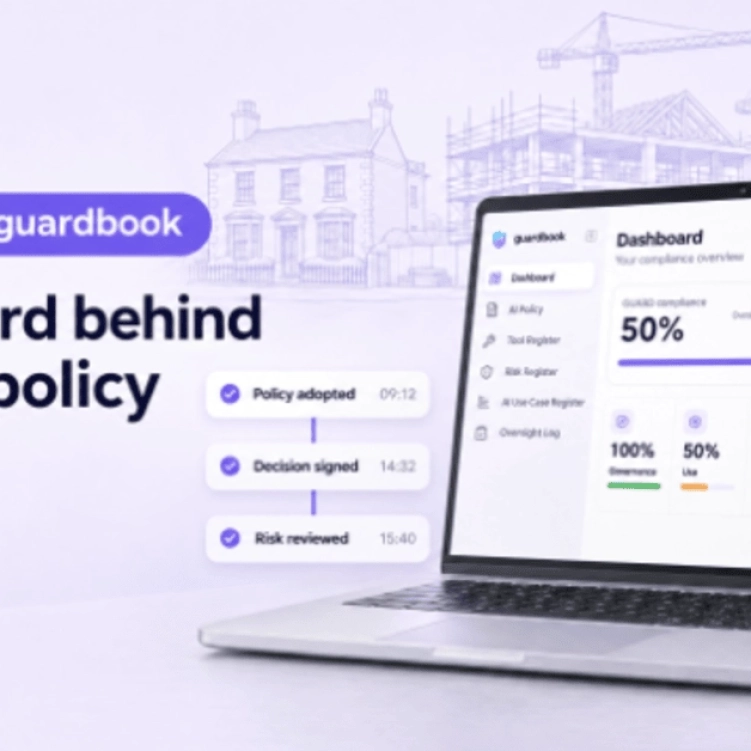
Guardbook is the tool Chris Brady and I have built to keep the evidence in one place. It gives a firm:
- a register of the AI tools in use
- the records the standard asks for, kept as you go
- training built in, developed by me
- a built-in guide that answers questions on the RICS standard
Early testers have given us excellent feedback, and we’re now talking to software companies about the tool register.
We’re running a live demo of Guardbook on . It’s free, and you’ll see the register, the record keeping and the built-in guide working, with time for questions. Book your place here. You can find out more at guardbook.ai. I’m really excited to show you what we have been working on.
I’d much rather this prediction ages badly. The best way to make sure it doesn’t come true for your firm is boring, cheap and entirely in your control.
Until next week folks and thanks for reading as always
Nina Young FCA
Links and sources
RICS: Surveying skills report, UK snapshot, November 2026 (PDF)
RICS: Responsible use of AI in surveying practice (PDF)
RICS: Surveying skills report 2026, global findings
Property Industry Eye: UK snapshot coverage
Anthropic: How AI agents shape experts’ judgment calls
Project Flux: further reading on the RICS skills data

Nina Young
Founder & CEO, Surveyors UK